Back
Geneva, Switzerland
Competition, Charmilles School
| Program |
• Classrooms (existing + three new) • Specialized rooms (visual arts, book workshop, games, rhythm and movement) • Offices and administration • Nurse’s office • After-school facilities • School cafeteria (approx. 220 m²) • Gymnasium • Covered and open playground areas • Play areas • Landscaped outdoor spaces • Bicycle parking (approx. 60 spaces) |
| Client | City of Geneva |
| Competition | 2026 (1st place, 1st prize) |
| Planning / Construction | 2026 - to be determined |
| Services provided by IB |
|
| Surface area | 7'400 m2 |
| Construction volume | 27'327 m3 |
| Building costs | 61.7 Mio. CHF excl. VAT |
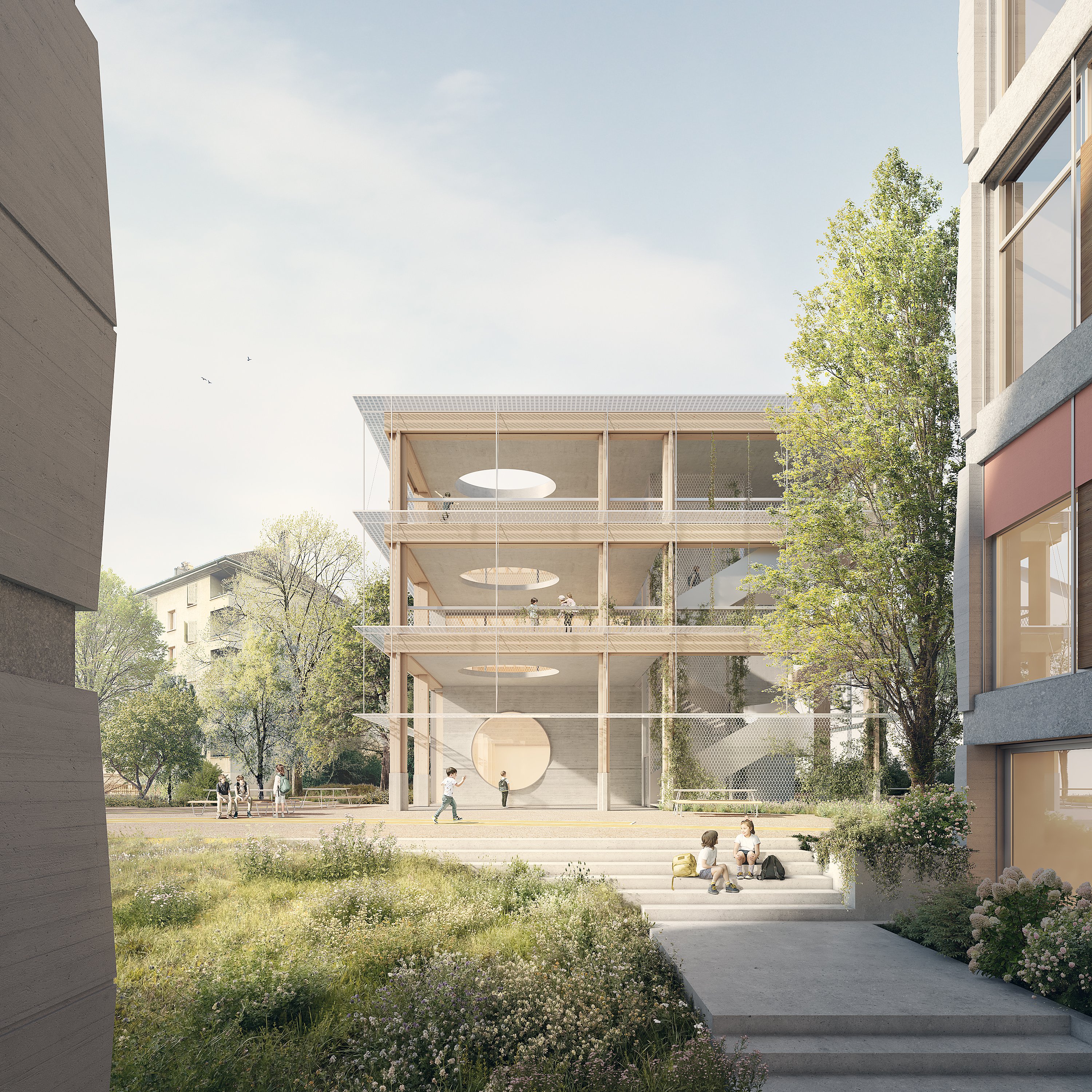
The City of Geneva seeks to enhance the Charmilles school complex in response to the neighborhood’s growing needs. The project includes the restoration of the Charmilles School, its extension to increase capacity, and the renovation of the Charles-Giron School. It also involves a comprehensive redesign of the outdoor spaces, with particular attention to landscape quality and everyday use.
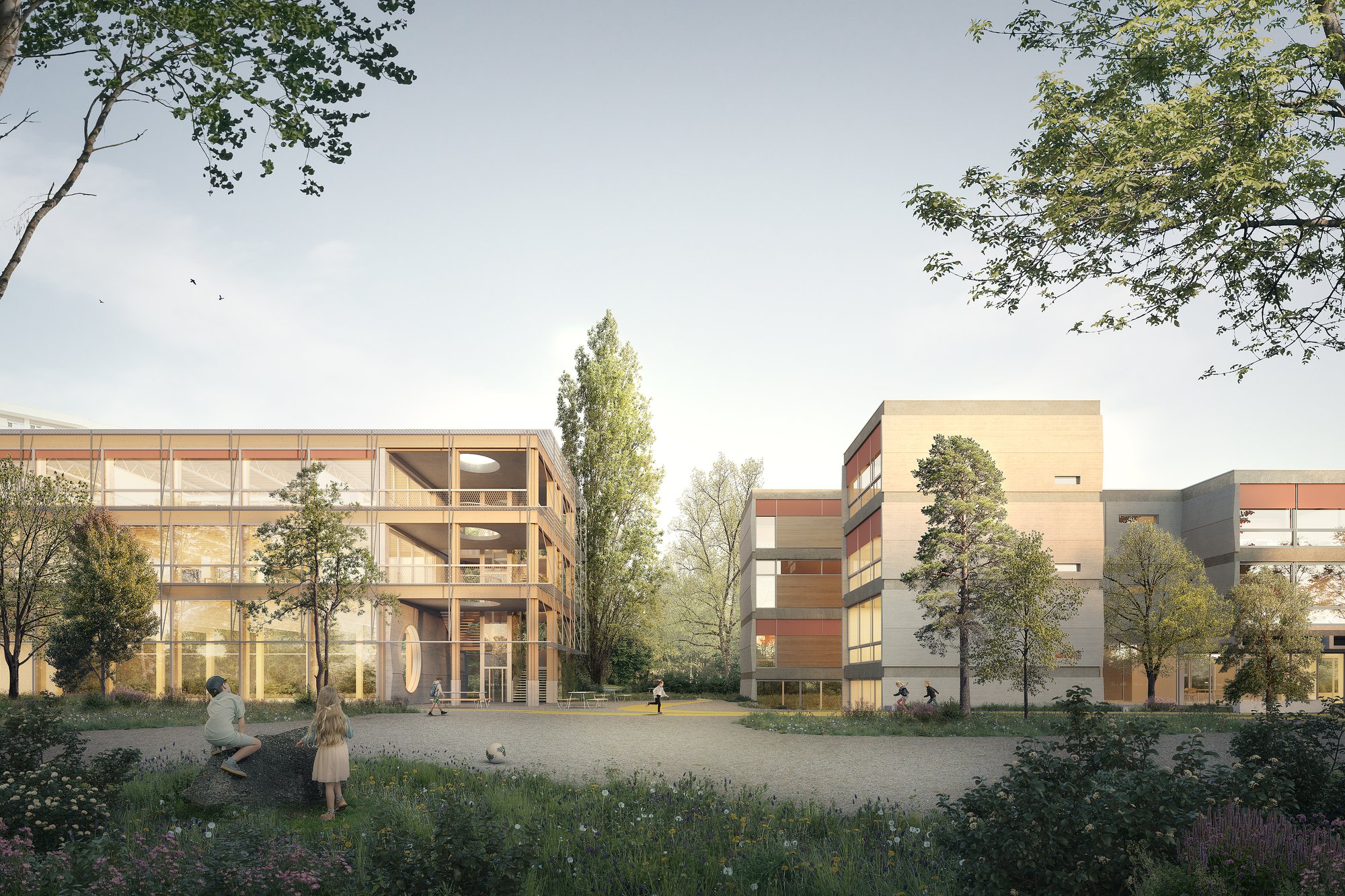
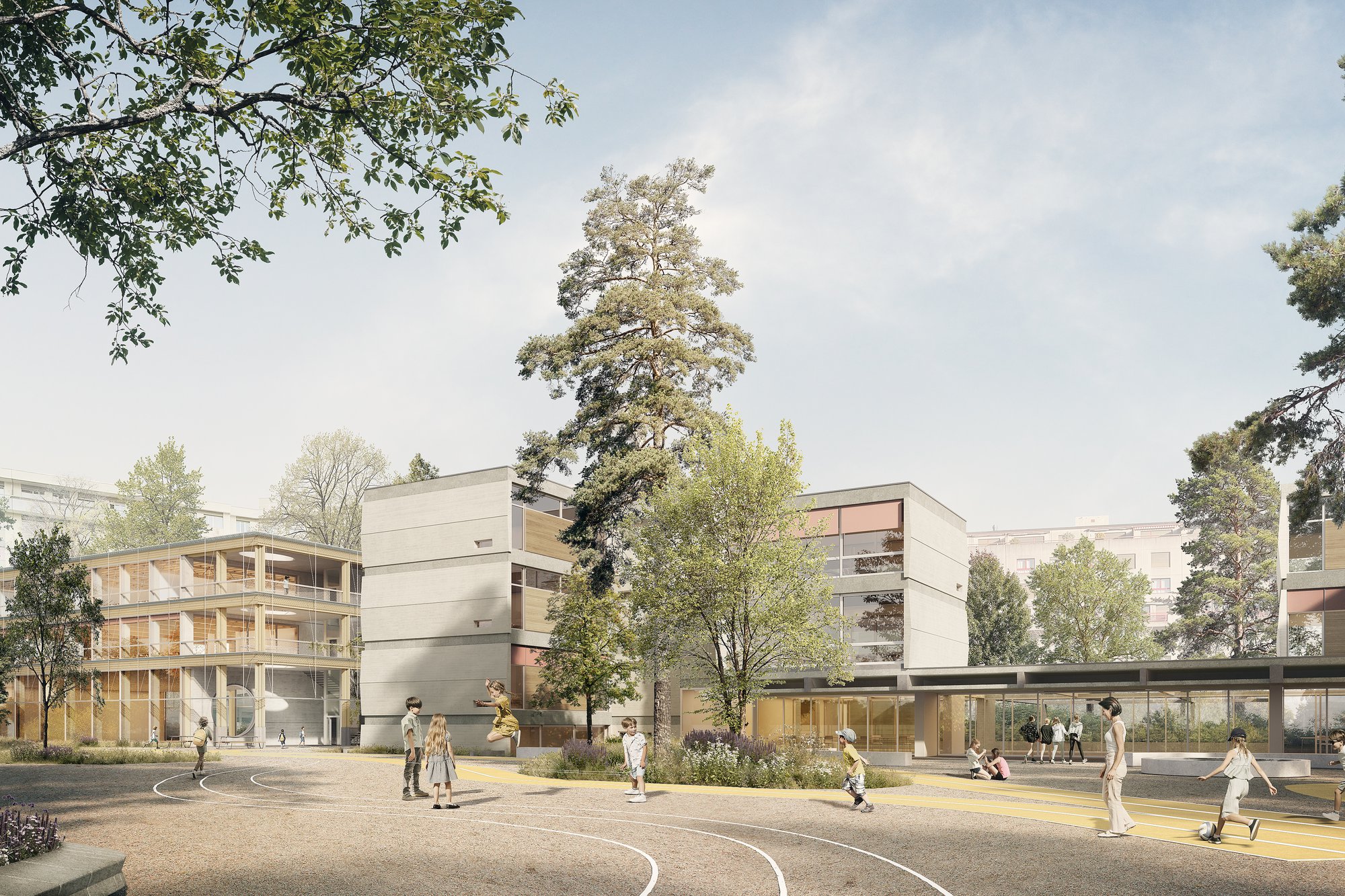
This approach is part of a broader reconfiguration of the school site. Its primary objective is to organize relationships between the different entities, establish clear urban connections, and improve the quality of outdoor spaces. The project aims to create a structured, adaptable, and welcoming environment, closely articulating building and ground, and positioning the school complex as a fully integrated component of the neighborhood.
The concept stands out for its thoughtful engagement with the existing heritage. By drawing on the site’s original logic, it reveals its contemporary relevance and reaffirms foundational principles: openness, permeability, and the organization of autonomous units around shared spaces. The intervention preserves the material and spatial qualities of the school without compromising its architectural balance, adopting a measured approach that avoids overburdening the existing fabric.
From a functional standpoint, the proposed organization is clear and efficient, aligned with contemporary uses. It encourages interaction and provides an environment suited to current educational principles.
Special attention is given to the outdoor spaces, conceived as places in their own right—supporting exchange, circulation, and daily life. Their reorganization improves the legibility of paths and uses while significantly increasing vegetated areas. The project is structured around the creation of a school park, designed as a true landscape infrastructure that extends the architecture and strengthens continuity between interior and exterior spaces.
The environmental dimension is reflected in limited excavation, simple structural choices, and the use of timber. The strategy is based on reuse and restraint, prioritizing the preservation and optimization of existing elements, the reuse of structures, and a reduction in carbon impact. This is complemented by a landscape approach that includes a fully preserved and enhanced tree canopy and integrated stormwater management.
This logic extends to the construction strategy, centered on retaining the existing gymnasium basin, maintaining the structural framework, and reusing components, thereby reducing the resources required. The compactness of the new volume and a lightweight structural system further enhance the overall efficiency of the complex.
Finally, by reinforcing landscape and urban continuities, the project goes beyond the scale of the school itself to assert a broader urban and social role: transforming the site into a shared resource capable of accommodating diverse uses and becoming an active hub within the neighborhood.


